
Community Care Connections Program Replication
Purpose: The Community Care Connections (CCC) program launched in 2016 to address health-related social needs for older adults and unnecessary emergency room visits and hospitalizations.
With almost ten years of experience, we now offer teaching and training in program replication. The CCC program manual is available for download.
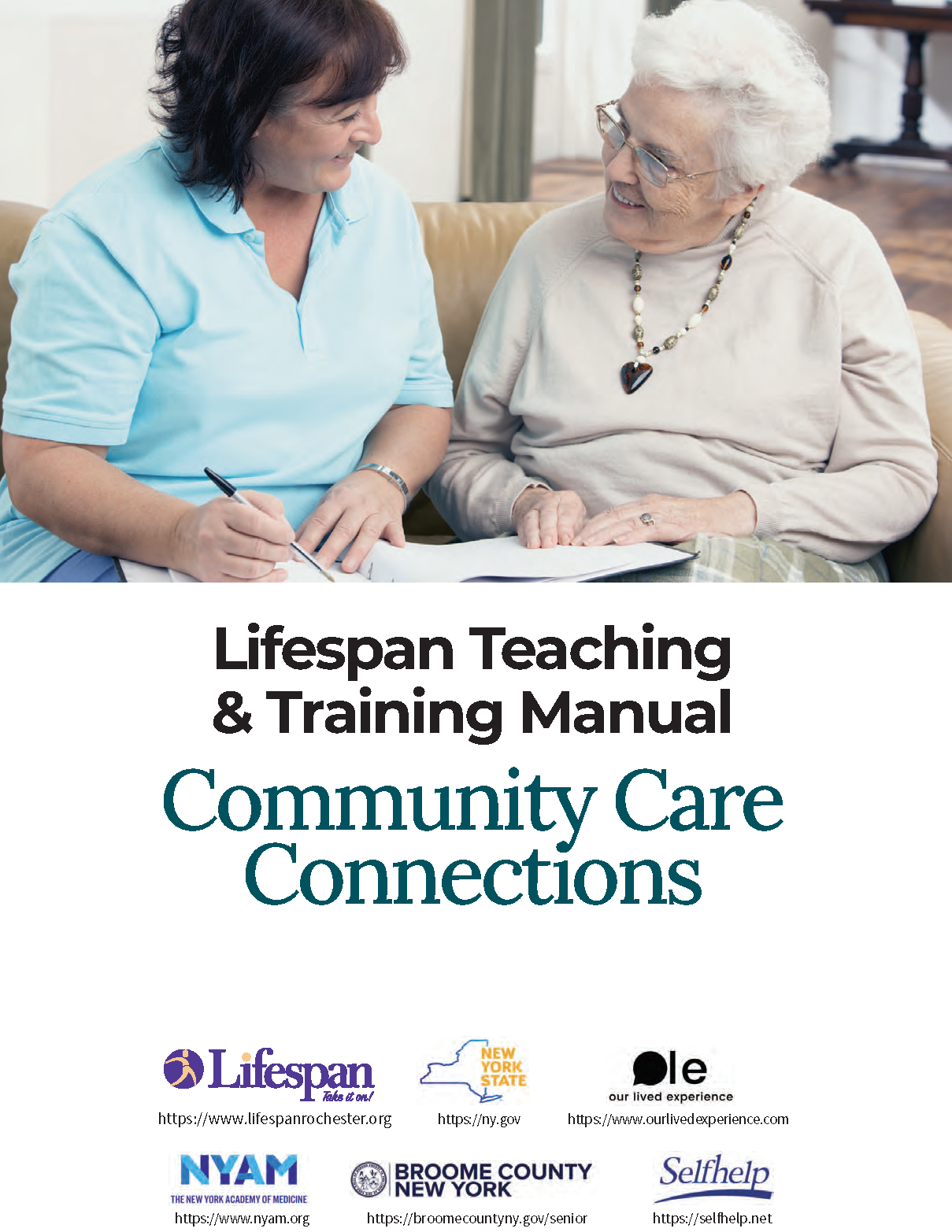
Teaching and Training for Replication
Lifespan offers teaching and training on the CCC model of integrating social and community-based services with primary care through social work care managers and healthcare navigators. This approach involves partnerships with medical providers, payers, social service organizations, and families. We not only see ourselves as partners in the important work of caring for older adults, but also in building the capacity of a broader community ecosystem to help older adults and their caregivers thrive.
Our manual provides a comprehensive guide for implementing and sustaining the CCC model, focusing on integrated care for older adults, partnership building, staff training, and continuous evaluation to improve outcomes and demonstrate value.
About Lifespan
Lifespan is a nonprofit organization based in Rochester, NY, serving older adults and caregivers since 1971. We provide over 30 services, advocacy, and training for professionals and the community, assisting around 30,000 people annually. Lifespan is supported by various government, foundation, and private sources and employs about 200 staff.
Community Care Connections (CCC) Program
Launched in 2016, CCC integrates community-based aging services with healthcare systems to address health-related social needs for older adults.
The program aims to reduce unnecessary emergency visits and hospitalizations by bridging gaps between social services and medical care.
CCC serves high-need, medically complex adults (age 60+), working closely with families, caregivers, and healthcare providers.
Training & Teaching Structure
Partnerships typically involve a 1–2 year engagement with activities such as kickoff events, leadership calls, case conferences, data evaluation meetings, and wrap-up events.
Training covers topics like community asset mapping, care philosophy, hiring practices, team structure, and patient-visit modeling.
CCC Model & Impact
Care teams consist of social work care managers and healthcare coordinators (LPNs or medical liaisons).
Services include home visits, assessments, care planning, healthcare navigation, and linking clients to community resources.
CCC has demonstrated measurable outcomes:
17% decrease in inpatient hospitalizations.
28% decrease in emergency room visits.
21% decrease in observation stays.
Core Principles & Practices
Emphasizes client autonomy, unconditional positive regard, motivational interviewing, empathy, harm reduction, and healing-centered engagement.
Staff support includes burnout prevention and regular supervision.
Workflows & Processes
Referrals come from healthcare providers and social service agencies.
The care process involves intake, assessment, care planning, service connections, documentation, and follow-up.
The manual includes forms and best practices for intake, assessment, and documentation.
Data Tracking & Evaluation
Data is tracked for referrals, enrollment, demographics, service units, formal service connections, and outreach.
Evaluation supports program goals, funding, and demonstrates value to stakeholders.
Demonstrating Value & Sustainability
Value is shown through outcomes, strong partnerships, and testimonials from clients and medical professionals.
Lifespan has sustained CCC through diverse funding sources and seeks ongoing support, including potential Medicare reimbursement.
What Data Is Tracked?
1. Referral Tracking
Records all clients referred to the program.
Analyzes whether referred clients were enrolled or not.
2. Client Information: Enrollment & Demographics
Tracks client demographics (age, ethnicity, county, veteran status, etc.).
Monitors enrollment dates and closure dates for each client.
3. Unit Reports: Shows the number of service units provided. Can be sorted by client list or care manager caseload.
4. Formal Service Reports: Tracks connections to community-based and healthcare services for each client.
5. Outreach Tracking: Documents the program’s efforts to connect with the broader community.
How Is Data Managed?
Data may be stored in an Electronic Care Management Record (ECMR) system or in Excel spreadsheets. The Healthcare Navigation Tracker is used to monitor non-social work items (e.g., vaccinations, allergies, pharmacy needs, transportation, medication, diagnosis details, and appointments).
Evaluation Activities
Program Level Evaluation: Tracks and reports progress to validate funding and support future funding applications.
Experience Capture: Collects feedback from patients, caregivers, and providers to add qualitative value.
Demonstrating Value: Uses both quantitative metrics (like reduced hospitalizations) and qualitative feedback (testimonials) to show program effectiveness.
Why Is This Important?
Accurate data tracking ensures accountability and transparency.
Evaluation supports continuous improvement and helps communicate the program’s success to funders, partners, and the community.
It enables Lifespan to adapt services, secure sustainable funding, and expand the CCC model.


